Why We Install Polyglass Self-Adhered Underlayment on Scottsdale Tile Roofs
Share this Article
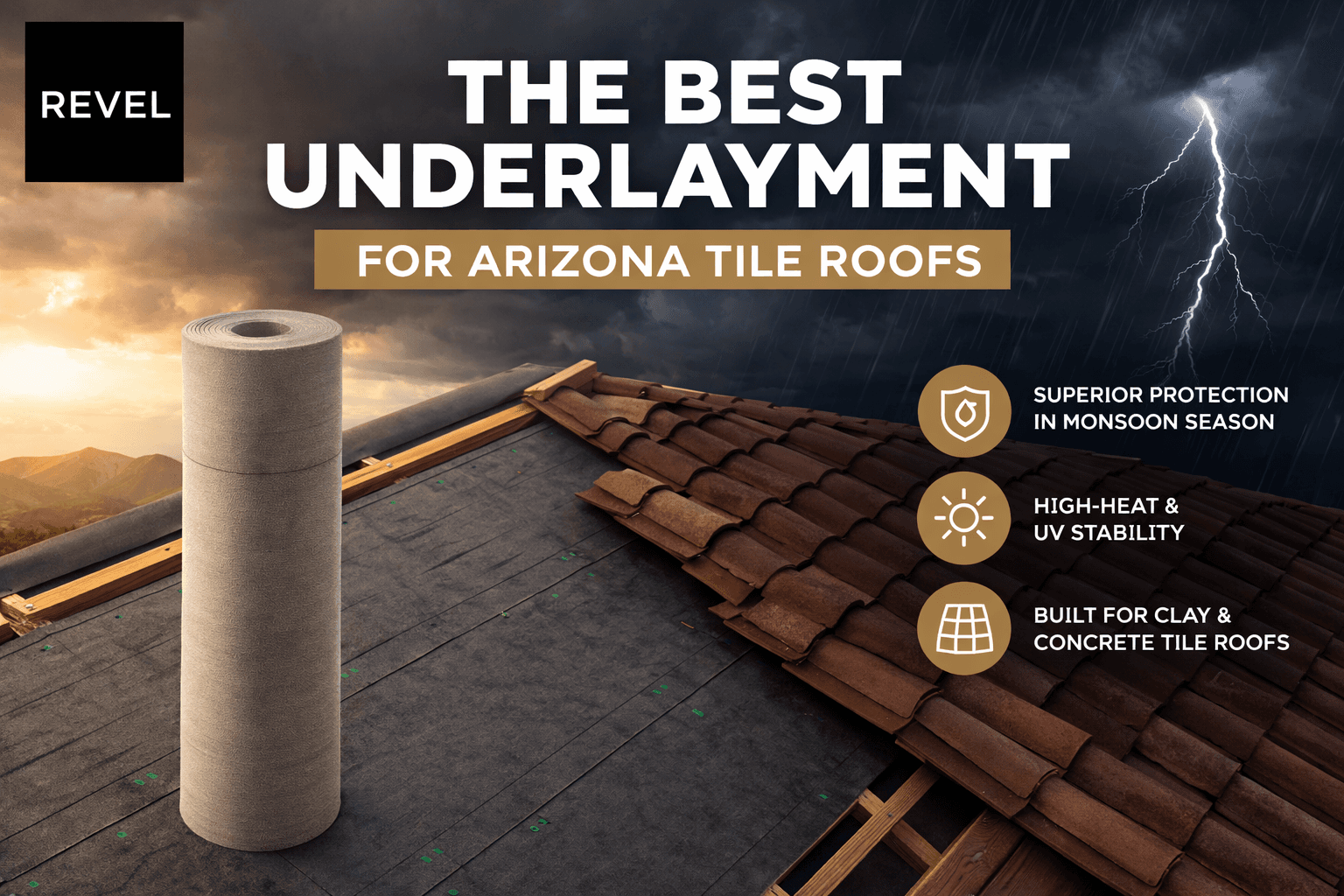
Ask most homeowners what protects their house from the rain and they'll point to the tile. Ask a roofer, and they'll point to what's underneath it. On a tile roof, the tile sheds the water and takes the sun — but the underlayment is the actual waterproofing layer. In Scottsdale's climate, the underlayment you choose is the single biggest factor in how long your roof lasts.
At Revel Roofing, we install Polyglass self-adhered (peel-and-stick) underlayment — specifically the Polystick line — on our tile roof systems. Here's why we've standardized on it, and what it means for the life of your roof.
The tile isn't the waterproofing — the underlayment is
Concrete and clay tile are built to shed water and shield the roof from UV, but a tile roof is not watertight on its own. Wind-driven monsoon rain, thermal expansion gaps, and the occasional cracked or slipped tile all let water past the surface. When that happens, the only thing between the water and your wood deck — and the ceilings below — is the underlayment.
That's why, when we re-roof a tile home, we're really replacing the underlayment. In most cases the existing tile can be lifted, the failed underlayment stripped, and the same tile re-laid over a fresh membrane. The tile can last 50+ years; the underlayment is what wears out first.
Why Scottsdale's heat is so hard on underlayment
Under dark tile in direct Arizona sun, roof-deck temperatures routinely climb well past 160°F. That heat is relentless — day after day, summer after summer. Traditional 30-lb. asphalt-saturated felt simply isn't built for it. The oils that keep felt flexible bake out over time, and the paper dries, shrinks, and cracks. Plenty of felt underlayments in the Valley start failing in well under a decade — long before the tile above them is anywhere near the end of its life.
Add monsoon season — sudden, wind-driven downpours that push water sideways and uphill under the tile — and you have the exact conditions a premium self-adhered membrane is engineered to survive.
What makes Polyglass different: ADESO self-adhered technology
Polyglass builds its Polystick underlayments using ADESO® dual-compound technology — two different compounds laminated into one membrane. The top is a UV-resistant, polymer-modified (plastomeric) compound that stands up to sun and foot traffic during installation. The bottom is an aggressive self-adhesive (elastomeric SBS) compound that bonds directly to the roof deck.
That fully-adhered bond is the whole point. Unlike felt, which is nailed down — and every nail is a potential leak path — a peel-and-stick membrane seals to the deck across its entire surface and self-seals around fasteners. Where tiles are mechanically attached, the rubberized asphalt closes tightly around each nail. Water has nowhere to travel. For the full felt-versus-peel-and-stick comparison, see our guide to the best underlayment for tile roofs.
Polystick TU Plus: built for 265°F roof decks
The workhorse product we rely on for tile is Polyglass Polystick TU Plus, a self-adhered underlayment engineered specifically for tile and metal roofs in high-heat environments. A few specs that matter in Scottsdale:
Rated to 265°F under tile — comfortably above the deck temperatures our roofs actually see.
Up to 180 days of UV exposure, so the roof stays protected across a multi-phase tile installation.
Dual reinforcement — an internal fiberglass mat plus a polyester surface fabric — for puncture resistance under the weight of heavy concrete and clay tile.
Works with both adhesive-set and mechanically-attached tile, sealing around correctly installed fasteners.
In plain terms: it's a membrane designed to outlast the heat, not just survive one summer of it.
Why our Polyglass Trusted Contractor status matters to you
Revel Roofing is a Polyglass Trusted Contractor. That's not a sticker — it's a manufacturer certification that requires trained crews and installations that meet Polyglass's published specifications. For you, that means two things. First, the product is installed the way it was engineered to be installed — and details, not materials, are where most roofs actually fail. Second, qualifying installations are eligible for an enhanced 30-year material and labor warranty, backed by the manufacturer, not just the contractor.
Cheaper roofs cut corners right here: a builder-grade felt or a bargain synthetic, nailed down fast, that looks identical from the street the day it's finished. The difference shows up in year six, not year one.
Frequently asked questions
How long does Polyglass underlayment last on an Arizona tile roof?
A properly installed self-adhered membrane like Polystick TU Plus is engineered to last decades in high-heat conditions — which is why qualifying Revel installations carry a 30-year material and labor warranty. Traditional felt often needs replacement in well under 10 years.
Do I have to replace my tile to replace the underlayment?
Usually not. On most re-roofs we lift and reuse your existing tile, replace the worn underlayment beneath it, and re-lay the same tile — a major saving versus all-new tile.
Is self-adhered underlayment worth the extra cost?
On a Scottsdale tile roof, yes. The underlayment is the part that wears out, so spending a little more on the layer that actually keeps water out is the highest-return decision in the whole system.
The bottom line for Scottsdale homeowners
Your tile can last half a century. Whether your roof does comes down to what's underneath it. We install Polyglass self-adhered underlayment because it's built for exactly the heat-and-monsoon cycle our homes face — and because we'd rather do it right once than chase leaks later.
Thinking about a new tile roof, or wondering whether your current underlayment is nearing the end? Give us a call for a free estimate and we'll take a look.